How to Build a Crypto Trading Bot With Claude AI in 2026 for Automated Market Testing
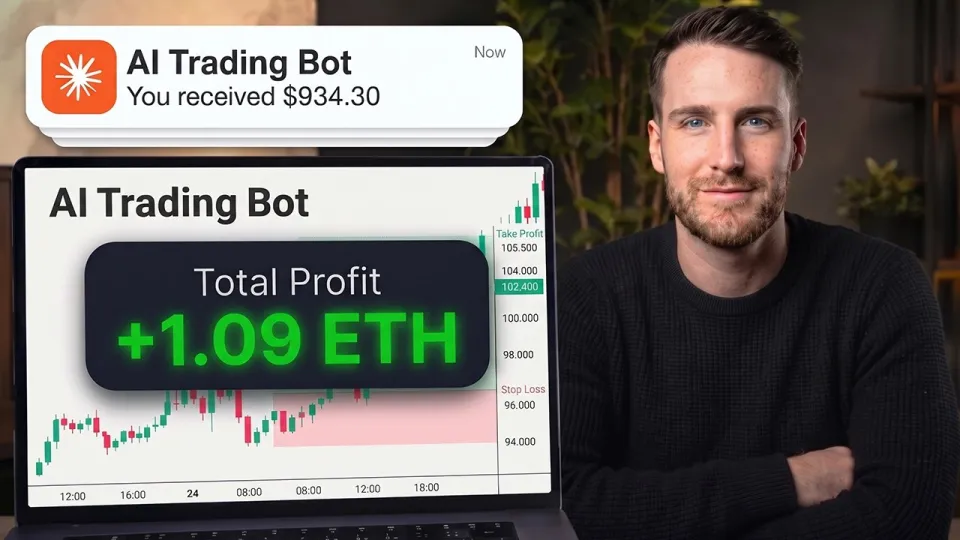
Video: Claude AI Trading: How to Build an AI Trading Bot (Crypto Trading Bot Live Test)
· based on the channel Edward Morgan
A crypto trading bot built with Claude AI is an automated program that connects to an exchange, reads live market data, applies a strategy written in plain instructions, and places buy and sell orders without manual input. The practical route is to let Claude generate and refine the code while you define the rules, then test the bot on a small balance before scaling. Edward Morgan's walkthrough covers this exact path, and the full guide, including the setup resources for the build, is available at the complete Claude AI trading guide.
What an AI crypto trading bot actually does
An AI crypto trading bot is software that replaces the manual loop of watching charts and clicking buttons with a repeating cycle of data collection, decision-making and execution. The "AI" part usually means one of two things: a large language model writes and maintains the code, or a model produces signals that a rule-based engine executes. Claude AI falls mainly into the first category — it is a coding assistant that turns a described strategy into working Python, JavaScript or a no-code configuration.
The core loop of any bot looks the same regardless of the model behind it:
- Market data — pull prices, candles or order book depth from an exchange API (Binance, Bybit, Coinbase, Kraken) every few seconds or minutes.
- Signal logic — evaluate the data against rules such as a moving-average crossover, RSI threshold, breakout level or funding-rate extreme.
- Position sizing — decide how much capital each trade uses based on account balance and stop distance.
- Execution — send market or limit orders through signed API requests.
- Risk control — enforce stop-losses, take-profits, maximum daily loss and a kill switch.
Claude's value is speed: instead of writing the exchange wrapper, the retry logic and the order manager from scratch, you describe them and review the output. That shortens a project that once took weeks into an afternoon, but it does not remove the need to understand what the code does.
How to build an AI trading bot with Claude AI step by step
Building the bot starts with a written strategy, not with code, because the model can only implement rules you can state precisely. Write down the exact entry condition, exit condition, timeframe, pair and position size before opening a chat with Claude. Vague prompts like "make me a profitable bot" produce vague code.
A workable build sequence:
- Define the strategy in plain English. Example: "Buy BTC/USDT when the 20-period EMA crosses above the 50-period EMA on the 15-minute chart; exit when the cross reverses or the stop at 1.5% is hit."
- Choose the stack. Python with `ccxt` for exchange connectivity and `pandas` for indicators is the most common choice; Node.js works equally well if you prefer JavaScript.
- Ask Claude for the skeleton. Request separate modules for data fetching, indicators, strategy, order execution and logging, so each part can be tested alone.
- Add exchange credentials via environment variables. Never hard-code API keys in the script; use read-and-trade permissions only and disable withdrawal rights on the key.
- Backtest before going live. Feed historical candles through the same strategy function and check drawdown, win rate and trade count.
- Paper trade on a testnet. Binance Testnet or Bybit's demo environment lets the bot run against real market data with fake funds.
- Deploy and monitor. Run it on a VPS or a small cloud instance, log every order, and set an alert for errors and for daily loss limits.
A prompt pattern that works well with Claude is to ask for one module at a time, paste the resulting code back and request a review for edge cases — rate limits, partial fills, network timeouts, duplicate orders. Bots fail on these details far more often than on the strategy itself.
Connecting the bot to an exchange and running the live test
The live test is where the bot meets real spreads, fees and latency, and it should begin with the smallest position size the exchange allows. Edward Morgan's video runs the finished bot against live crypto markets to see how it behaves outside a backtest, which is the only way to catch problems such as orders rejected for insufficient balance or signals firing on incomplete candles.
Practical checks during the first live session:
- Fee impact. A taker fee of 0.04–0.10% per side on a strategy that targets 0.5% moves eats a large share of gross profit; calculate net expectancy before increasing size.
- Slippage. Market orders on thin pairs fill worse than the chart suggests; log the difference between expected and filled price.
- Rate limits. Exchanges cap requests per minute; a bot polling every second across many pairs will hit them and start receiving errors.
- Clock sync. Signed requests fail if the server timestamp drifts; most libraries handle this, but verify.
- Kill switch. A hard rule that stops trading after a set daily loss or a number of consecutive losing trades.
Expect the live results to differ from the backtest. That gap is information, not failure — it tells you whether the strategy is robust or curve-fitted to history.
Typical questions and doubts about automated crypto trading
The most common hesitation around crypto trading bots is whether they can be trusted with real money at all, and the honest answer is that trust comes from testing, not from the model. A bot written by Claude is still your responsibility: you own the logic, the keys and the risk limits. Treat the first weeks as an experiment with capital you can afford to lose entirely.
Other recurring concerns:
- "Will the AI make trading decisions for me?" Claude writes and explains code; the trading rules remain yours unless you deliberately add a model that scores signals.
- "Do I need programming experience?" Basic Python literacy helps enormously with debugging, but the model can explain each line on request.
- "What about taxes and regulation?" Automated trading does not change your reporting obligations; keep full logs of every fill.
- "How much capital do I need?" Enough to survive fees and minimum order sizes — often a few hundred dollars at minimum on major pairs, and more if the strategy trades frequently.
- "Can I run several bots?" Yes, but each one multiplies operational risk; start with one strategy on one pair.
Risks and limits of Claude-built trading bots
A bot generated by a language model can be syntactically perfect and still lose money, because code quality and edge are different things. The model has no knowledge of future prices, cannot guarantee profitability, and may reproduce common strategy patterns that are already widely traded and therefore less effective. Crypto is highly volatile, and leveraged positions can be liquidated within minutes during a sharp move.
Specific failure modes to guard against:
- Logic bugs that only appear live — for example, re-entering a position immediately after a stop-out.
- Silent crashes — a bot that stops running while holding an open position leaves it unmanaged.
- Over-optimization — a strategy tuned to one historical period often breaks in the next.
- Key exposure — leaked API keys with withdrawal permission are a total loss risk.
- Overconfidence after a good week — position sizes should scale with tested performance, not with recent luck.
None of this makes bot building pointless; it makes discipline mandatory. Position limits, a maximum daily loss and a manual override are not optional extras.
Resources and links from the walkthrough
The build in the video is supported by a single main resource page, which bundles the guide and setup material referenced during the tutorial:
- Full guide and setup resources: https://tr.ee/7m2goN
Summary
Building a crypto trading bot with Claude AI is a realistic afternoon-to-weekend project: describe the strategy precisely, let the model generate modular code, backtest it, then paper trade and run a small live test. The hard parts are not the code but the risk controls — fees, slippage, stop-losses and a kill switch decide the outcome more than the entry signal does. Edward Morgan's video breakdown is a useful starting point because it takes the bot all the way to a live test rather than stopping at the code editor. If you want the full setup guide used in that build, start with the complete guide here and treat your first deployment as a measured experiment, not a money machine.
Key takeaways
- Claude AI can generate the full bot codebase from a plain-language strategy description, including exchange API calls and order logic.
- A working crypto trading bot needs four parts: market data feed, strategy rules, order execution and risk management.
- Live testing should start on a testnet or with a tiny balance before any real capital is exposed.
- Edward Morgan's walkthrough splits the build into three stages: concept, construction and a live performance test.
- Fees, slippage and API rate limits usually decide whether a bot is profitable, not the entry signal alone.
Questions & answers
Can Claude AI really build a working crypto trading bot?
Yes, Claude can generate a complete bot in Python or JavaScript, including exchange API calls, indicator calculations and order management, if you describe the strategy precisely. The code still needs review, backtesting and a testnet run before it touches real funds, because the model cannot verify profitability.
Do I need coding skills to build an AI trading bot?
Basic programming literacy makes debugging far easier, but it is not strictly required to get a first version running. Claude can explain each function and fix errors you paste back, though you should understand what each order and risk parameter does before going live.
How much money should I start with when testing a crypto trading bot?
Start with the smallest amount the exchange allows, or use a testnet with fake funds, until the bot has traded through different market conditions. Fees and minimum order sizes mean very small balances can be eaten by costs, so plan for a few hundred dollars at minimum on major pairs.
Is an AI trading bot profitable?
No bot is guaranteed to be profitable; results depend on the strategy's edge, fees, slippage and risk management. Many beginner bots lose money because of over-optimized rules and unchecked costs, so treat early live results as data for improvement rather than proof of performance.
Source: Claude AI Trading: How to Build an AI Trading Bot (Crypto Trading Bot Live Test) · Markdown version