Forex Trading for Beginners
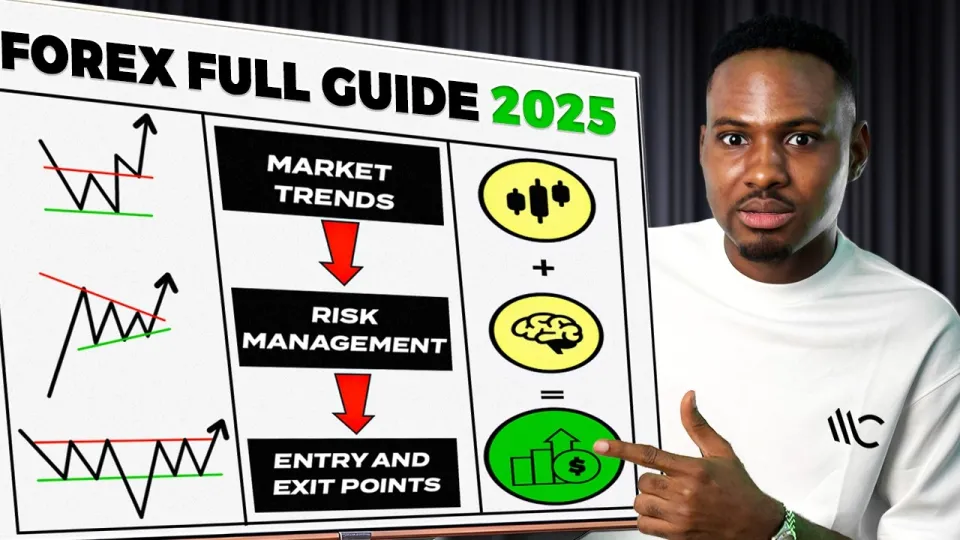
Video: How To Start Forex Trading For Beginners’ 2025 (Full Course)
Need articles like this for your video? They help promote it on YouTube and Google — order them in the Telegram bot @sat_sit_bot. It writes articles around your video, embeds the video and publishes them on popular niche websites (no ads). Free trial — 50 articles.
· based on the channel Jeffrey Benson Forex
Forex trading is the buying and selling of national currencies in pairs, and a beginner starts by learning how prices move, opening a demo account on a platform such as MetaTrader 5, and risking no more than 1% of the account on a single trade. The free full course from Jeffrey Benson Forex walks through exactly that path — what the market is, which tools are needed, how a first trade is placed and which mistakes cost beginners money — and its student plan is available at FirePips FX.
What forex trading actually is
Forex is a decentralised over-the-counter market where currencies are quoted in pairs: the first currency is the base, the second is the quote, and the price tells you how much of the quote currency one unit of the base costs. EUR/USD at 1.0850, for example, means one euro buys 1.0850 US dollars.
There is no single exchange and no opening bell. Trading runs electronically from Monday morning in Sydney to Friday evening in New York, and the value of a currency shifts with interest-rate decisions, inflation data, employment reports, political events and simple supply and demand. Because every trade is simultaneously a purchase of one currency and a sale of another, there is no such thing as a purely "long" or "short" market — there is only a view on which side of the pair will strengthen.
The most traded pair is EUR/USD, followed by USD/JPY and GBP/USD. Majors pair the US dollar with another major economy's currency; crosses skip the dollar entirely, such as EUR/GBP. Beginners usually do best on majors because spreads are tightest and news coverage is richest.
How the forex market works across sessions
The forex day is split into four sessions — Sydney, Tokyo, London and New York — and liquidity peaks when London and New York overlap, roughly the middle of the European afternoon. Spreads widen and price action gets choppy in the quiet hours between the New York close and the Tokyo open, which is why many beginners are told to trade only the two busiest sessions.
Prices are quoted with a bid (what a buyer offers) and an ask (what a seller wants); the gap is the spread, and it is the broker's main cost to you. Most retail brokers also charge swap, an overnight financing adjustment applied when a position is held past the daily rollover. Leverage is expressed as a ratio — 1:100 means a $1,000 deposit controls a $100,000 position — and it is the reason a small adverse move can wipe out an account.
Tools and setup every beginner needs
A workable beginner setup is small: a regulated broker account, a trading platform, a chart with a couple of indicators, an economic calendar and a notebook. The course recommends MetaTrader 5 as the platform and points to Assex Markets as the broker used in the walkthrough, with registration at https://my.assexmarkets.com/auth/register?partner_code=1699134.
The order of operations matters more than the tool list:
- Register with a broker and complete identity verification.
- Download MetaTrader 5 and connect the trading account to it.
- Open a demo account and trade virtual money until the mechanics feel routine.
- Fund a live account only after a demo record shows consistent process, not lucky wins.
- Keep a trading journal recording pair, session, entry, stop, target and the reason for each trade.
On the chart, a beginner needs little beyond candlesticks, a moving average, support and resistance levels and the economic calendar. Position size is calculated from risk, not from how confident a trade feels: with a $1,000 account and 1% risk, the maximum loss on a trade is $10, and the lot size is derived from the distance to the stop-loss. A standard lot is 100,000 units, a mini lot 10,000 and a micro lot 1,000, so micro lots are the practical starting point.
A basic strategy foundation before the first trade
A beginner strategy is a written set of conditions for entry, exit and risk, tested on a demo account before real money is involved. The course builds one around market structure: identify the trend on a higher timeframe, mark the levels where price previously reversed, and wait for a pullback into that zone rather than chasing a candle that has already moved.
Three rules keep the process honest. First, one setup per trade — mixing a trend-following entry with a counter-trend guess produces a position nobody can evaluate. Second, a stop-loss placed before entry, at a level that invalidates the idea rather than at a round dollar amount. Third, a target of at least twice the risk, so a strategy that wins only half the time can still be profitable.
Placing the first trade then follows a fixed sequence: choose the pair, check the calendar for upcoming releases, set entry, stop-loss and take-profit, size the position, and log the trade. Trading a demo account for several weeks before going live is not a delay; it is the cheapest way to discover whether the plan survives contact with real spreads and slippage.
Common mistakes that cost beginners money
The mistakes that empty beginner accounts are consistent: too much leverage, no stop-loss, revenge trading after a loss and following signals without understanding them. Risking 10% per trade means five consecutive losses cut the account in half, and five losses in a row is a normal event for any strategy.
Other frequent errors are trading during low-liquidity hours, moving a stop-loss further away to avoid being stopped out, averaging into a losing position, and switching strategies after two bad trades. Over-trading is equally damaging — a beginner who takes fifteen setups a day pays fifteen spreads and makes fifteen emotional decisions.
A separate trap is signal copying. Channels such as https://t.me/firepipsignals publish free daily trade ideas, and a premium group is offered through https://t.me/jeffreybenzhelpbot, but copying entries without the underlying risk model leaves the follower unable to judge when to exit or how much to risk. Signals can supplement a tested plan; they cannot replace one.
Questions beginners ask most
Viewers of the course repeatedly ask how long it takes before trading becomes profitable, and the honest answer is that it depends on the process, not the calendar: months of demo and small live trades are normal before results stabilise. Another recurring concern is whether a beginner can trade with a small deposit — yes, with micro lots and strict 1% risk, though expectations should match the account size.
A third theme is fear of the market itself. Much of that fear disappears once the mechanics are understood: a stop-loss defines the worst case in advance, and a demo account removes money from the equation while learning. The most common regret expressed by viewers is time spent on scattered videos before finding a structured course — which is the argument for working through one curriculum in order, taking notes, and returning to the same material on a demo account.
Useful links
- Student plans and course access: https://firepipsfx.com/plans
- Free daily signal channel: https://t.me/firepipsignals
- Broker registration used in the course: https://my.assexmarkets.com/auth/register?partner_code=1699134
- Premium signal group bot: https://t.me/jeffreybenzhelpbot
Final thoughts
Forex trading rewards a repeatable process far more than a clever prediction: learn how pairs are quoted, trade the liquid sessions, size positions from a fixed 1% risk, and keep a journal from the very first demo trade. The full course by Jeffrey Benson Forex is a solid structured starting point because it moves from market mechanics to tools, strategy and the mistakes that matter, rather than jumping straight to entries. Work through it once for understanding and a second time with a chart open, and treat the student plans as an optional next step rather than a shortcut past practice.
Key takeaways
- Forex is the market where national currencies are traded in pairs such as EUR/USD; price moves come from supply and demand, interest rates and news.
- The four sessions — Sydney, Tokyo, London and New York — overlap, and the London–New York overlap is the busiest window for major pairs.
- A standard lot is 100,000 units of the base currency; a mini lot is 10,000 and a micro lot is 1,000.
- Leverage multiplies both gains and losses, so a 1% risk per trade and a stop-loss are baseline rules, not extras.
- A demo account on MetaTrader 5 lets a beginner place trades with virtual money before funding a live account.
Questions & answers
How much money do I need to start forex trading?
You can open a live account with a few hundred dollars if you trade micro lots and keep risk at 1% per trade, but the account must be large enough that a normal losing streak does not end it. Many beginners spend several weeks on a demo account first, which costs nothing and teaches the platform mechanics.
Is forex trading gambling?
It becomes gambling when position size is chosen by confidence rather than by a fixed risk rule. With a written setup, a stop-loss placed before entry and a maximum 1% loss per trade, the outcome over many trades is a statistical distribution rather than a bet.
Can I copy someone else's trades instead of learning?
Copying signals is possible, and free daily ideas are published in public channels, but followers who do not understand the risk model cannot judge when to exit or how much to allocate. Signals work best as confirmation for a plan you already tested yourself.
Which session is best for a beginner to trade?
The London and New York overlap offers the tightest spreads and the most volume on major pairs, which makes it the most forgiving window. The quiet hours between the New York close and the Tokyo open tend to produce choppy moves and wider spreads.
Source: How To Start Forex Trading For Beginners’ 2025 (Full Course) · Markdown version